
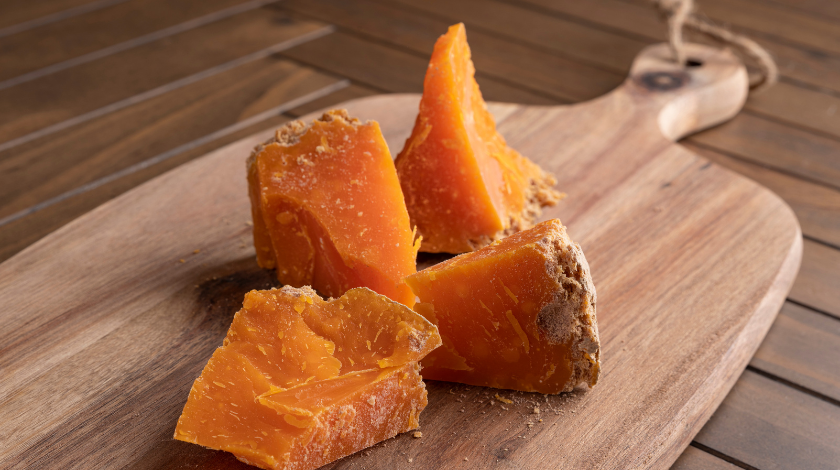
I remember the first time I saw a full wheel of Mimolette. I was in a tiny fromagerie in Paris, surrounded by the familiar scents of Camembert and Comté, when my eyes landed on something that looked like it had fallen from a spaceship. It was a perfect, dusty orb, the color of a autumn pumpkin, but its surface was pocked and cratered like the moon. The cheesemonger saw my curiosity, gave it a firm tap with his knife, and a satisfying, deep thunk echoed through the shop. “That,” he said with a grin, “is the Boule de Lille. The cheese with character.” He was right. Mimolette isn’t just a cheese; it’s an experience, a story, and a little bit of edible controversy wrapped in a hard, orange shell.
Let’s pull up a chair, grab a cracker, and unravel the story of this fascinating cheese together. I promise, by the end, you’ll see it not as a weird oddity, but as a champion of traditional cheesemaking.
What Exactly Is Mimolette?
At its heart, Mimolette is a hard French cheese that originally hails from the city of Lille, up in the Nord-Pas-de-Calais region near the Belgian border. Its story starts in the 17th century under the rule of the Sun King, Louis XIV. France was often at odds with the Dutch, and back then, a popular import was Edam cheese from the Netherlands—those cute, red-waxed yellow balls. King Louis, wanting to boost French production and cut imports, ordered a local version to be made. The cheesemakers of Lille got to work. They used a similar process but made a few key French tweaks. The most obvious? They dyed it a vibrant, bold orange using a natural coloring called annatto, made from the seeds of the achiote tree. This was partly to distinguish it from Edam, and partly, I like to think, to make it look as regal and striking as Louis XIV himself. They called it “Mimolette,” from the Old French word mimou, meaning “half-soft,” which refers to its early stages.
The Look: Orange Outside, Crazy Inside
That orange color is its calling card. When you slice into a young Mimolette, the interior is a uniform, bright orange. But as it ages, magic happens. The color deepens into a rich, burnt amber, and the texture changes completely. A young Mimolette (around 6 months) is firm but still slightly pliable, like a cheddar. A vieille (old) Mimolette, aged for 18 months or more, becomes incredibly hard. You need a sturdy knife, and sometimes even a cheese plane, to shave off pieces. These shavings are like salty, nutty confetti—perfect for grating over salads or pasta.
Then there’s the rind. This is where first-timers often pause. A proper, traditionally aged Mimolette rind is not smooth. It is deeply pitted, craggy, and dusty. For decades, this texture was lovingly created by tiny, microscopic roommates: cheese mites.
The Mite Conversation: Let’s Be Honest
This is the part that made Mimolette briefly infamous, especially in the United States around 2013. Yes, traditional Mimolette aging involves Tyroglyphus casei, the cheese mite. These aren’t bugs you can easily see; they’re minute creatures that naturally exist in cheese aging environments.
Here’s how it worked, and in some traditional affinage cellars, still works: The young cheese wheels are placed in humid rooms. The mites are introduced or occur naturally. They munch on the rind of the cheese, digesting the fats and creating those characteristic pits and tunnels. This process, cheesemakers argue, aids in dehydration and contributes to the development of the cheese’s complex, concentrated flavor. Periodically, the wheels are brushed to remove mite debris and rotated to ensure even “miting.”
Now, the controversy. The U.S. Food and Drug Administration (FDA) has strict limits on allowable insect fragments in food—a standard meant to ensure general food safety. In 2013, FDA inspectors at the border looked at some Mimolette shipments, saw an unusually high number of mites under the microscope, and blocked its import. Headlines screamed about “bug-infested cheese.”
It created a huge clash between modern food safety regulations and centuries-old artisanal practice. From the FDA’s perspective, they were enforcing clear rules. From the French perspective, and that of many cheesemongers and lovers, they were banning an integral part of the cheese’s identity and production—a process that, when controlled, is harmless and traditional.
What does this mean for you today? Most Mimolette now exported to the U.S., especially the younger varieties, is produced in a way that minimizes or eliminates mites, often using modern aging rooms that control the environment. The rind might be less cratered, but the soul of the cheese remains. If you’re in Europe, especially France or Belgium, you might still find the more traditionally aged versions. The key takeaway? There are no “bugs” in the cheese you eat. Any mites are strictly on the inedible rind and are brushed away before sale. It’s a part of its history, not a present danger.
A Flavor That Grows on You (Literally)
So, what does all this drama taste like? Mimolette is a cheese of remarkable transformation.
A young Mimolette (6 months) is approachable. It’s firm but not hard, with a mild, buttery, and slightly salty flavor. Think of it as a more colorful, slightly nuttier cousin to a young Gouda. It’s a great introduction.
An extra-vieille (extra old) Mimolette (18-24 months) is where the magic is for me. The texture is hard and crystalline, giving a delightful crunch. The flavor is powerful and complex: deeply nutty like toasted hazelnuts or pecans, with strong notes of burnt caramel and butterscotch. That initial saltiness intensifies into a savory, umami-rich punch. It’s not a cheese you eat in big chunks; you savor small shavings or slivers. Let it sit on your tongue. It starts salty, mellows into sweet caramel, and finishes with a long, nutty echo. It’s honestly one of the most satisfying flavor journeys in the cheese world.
How to Bring Mimolette Home and Enjoy It
You’re sold, right? Here’s how to make the most of it.
Buying It: Find a good cheesemonger, not just a supermarket fridge. Ask for their advice. Tell them you’re curious about Mimolette. They might let you taste a young and an aged piece to compare. Look for a wheel that feels heavy for its size with a rind that’s intact, even if it’s bumpy.
Serving It: Take it out of the fridge at least an hour before eating. Cold mutes its flavor. For young Mimolette, cube it. For old Mimolette, use a cheese plane to make elegant curls or a heavy knife to chip off rustic pieces. Put it on a board with some neutral crackers or a crusty baguette.
Pairing It:
-
Drinks: This is beer and cider country. A malty Belgian dubbel or a French bière de garde complements its nuttiness perfectly. A dry hard cider is also a classic, brilliant match. For wine, try an off-dry Riesling or a nutty Amontillado sherry to play with the sweet and salty notes.
-
Food: On a board, pair it with sweet things to contrast the salt: apple slices, fig jam, or dried apricots. Walnuts are a natural friend.
Cooking With It: Young Mimolette melts beautifully. Use it in a gourmet grilled cheese sandwich with some ham and apple. Grate vieille Mimolette over French onion soup, roasted vegetables, or a simple pasta with butter and black pepper. It adds a deep, savory, umami kick that Parmesan wishes it had.
Conclusion: A Cheese Worth the Conversation
Mimolette is more than food. It’s a piece of French history, a lesson in traditional craftsmanship, and a talking point about how we balance tradition with modern rules. Its bold color, unique texture, and evolving flavor profile make it a star on any cheese board. It challenges our expectations of what cheese should look like and reminds us that some of the best flavors come from processes we might not initially understand.
So next time you’re at a cheese counter, look for that orange cannonball. Don’t be shy. Ask about it. Taste it. You might just discover your new favorite cheese—one with a story as rich as its flavor.
Frequently Asked Questions (FAQ)
Q: Why is Mimolette cheese orange?
A: It’s colored with annatto, a natural, plant-based dye from the achiote tree. This was originally done to distinguish it from similar Dutch cheeses and make it visually striking.
Q: Is Mimolette cheese safe to eat?
A: Yes, absolutely. The cheese mites associated with its traditional aging are only on the rind, which is not eaten. Modern production, especially for export, tightly controls this process. The paste (the inside) of the cheese is mite-free.
Q: Can I eat the rind of Mimolette?
A: It is not recommended. The rind is very hard and, in traditionally aged versions, is the part that interacted with the aging environment (including mites). Simply cut it off and enjoy the delicious interior.
Q: What’s a good substitute for Mimolette?
A: For young Mimolette, try a young Gouda or Edam. For aged, vieille Mimolette, the closest in texture and salty-nutty flavor might be a very old Gouda or an aged Cantal. For grating, a dry Pecorino Romano can provide a similar salty punch, though the flavor profile is different.
Q: Where can I buy Mimolette in the USA?
A: It is available again! Look for it in specialty cheese shops, high-end grocery stores like Whole Foods, or from reputable online cheese retailers. Be sure to check the description or ask about its age.